
The videos toddlers watch may be reshaping their vocabularies in unexpected ways, according to new research from SMU.
Two related studies led by SMU psychologist Sarah Kucker found that children who spend more time watching videos and TV learn different types of words than their peers, and that a child’s temperament and their parents’ personality traits help explain why some families use more digital media in the first place.
“We know media is not just good or bad, it’s much more nuanced,” Kucker said.
A study of 388 caregivers published in Developmental Science found that toddlers with higher video exposure learned proportionally fewer words for body parts like “arm,” “nose” and “ear,” but more words for people and furniture.
“Touching your leg when you say the word leg is helpful for kids learning the word leg, or you think about parents always saying things like, ‘That’s your nose,’ and they touched your nose,” Kucker said. “You don’t get that through video.”
When they analyzed summaries of the videos parents reported their children watching most, about 65% referenced people words, including characters, family members, or occupations like police officer or firefighter.
The findings matter because early vocabulary composition can predict later language development. Children who know clusters of related words, including body parts, tend to have stronger word-learning abilities and faster vocabulary growth.
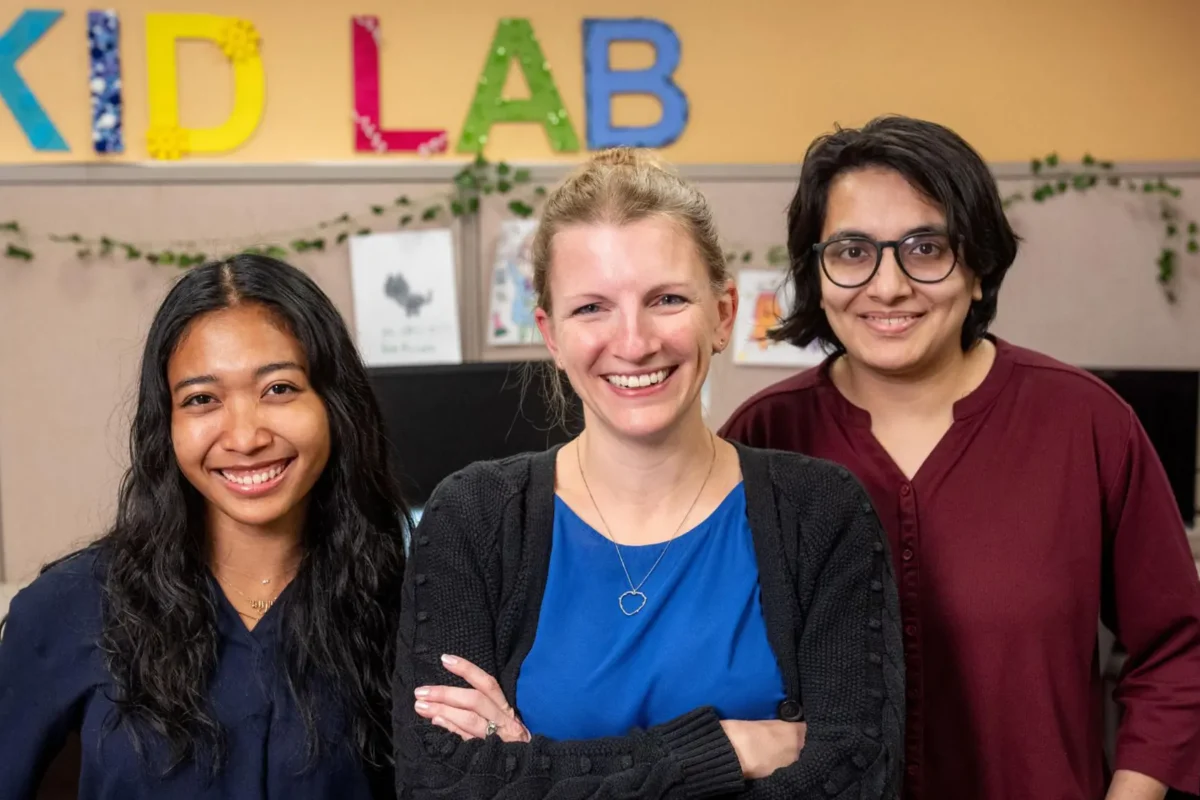
A second study, published in Developmental Psychology, examined why some families use more digital media than others. Kucker and SMU graduate students Syakira Wijaya and Sneh Jhaveri, along with collaborators at Georgetown University and the University of Miami, surveyed 464 caregivers and followed up with 90 families one year later.
The researchers found that parent personality matters. Parents who scored higher in conscientiousness, a trait associated with organization and self-discipline, tended to have children who spent less time with digital media.
Children’s own temperament also mattered. Toddlers with higher “negative affect,” a temperament trait characterized by fussiness and difficulty self-soothing, watched more videos, which in turn was linked to smaller vocabularies. The finding suggests some parents may turn to screens to calm difficult-to-soothe children, inadvertently creating a cycle that affects language development.
When the researchers followed up one year later, they found that the link between early media use and vocabulary held true across the board: children who used more digital media at age 2 had smaller vocabularies at age 3, regardless of their temperament or their parents’ personality traits.
Contrary to what the researchers expected, using videos for educational purposes or watching alongside children did not offset the negative relationship between screen time and vocabulary in this study.
Author