36 | Company: Church of the Incarnation | Education: University of Mississippi, Covenant Theological Seminary
Jordan Griesbeck is particularly passionate about serving people with disabilities in his role as a priest in the Episcopal Church.
“My wife and I are always seeking to befriend and encourage families in the Park Cities affected by disability — to help them see that their disabled children are a gift and not a burden,” he said. “This can be harder to see and feel in affluent communities, when families affected by disability feel “out of place” or ‘passed-by.’”
Griesbeck is Assistant Rector for Formation at the historic Church of the Incarnation in Dallas, the country’s second-largest Episcopal Church. He joined Incarnation after stints with large parishes in Austin and Dallas, as well as college ministry with the Reformed University Fellowship at the University of Texas at Austin and the University of Virginia.
He said he sees giving back as part of his job.
“I see involvement in the community as an extension of my work in the Church. If I didn’t care about my community, I couldn’t rightly be called a ‘priest.’ Churches should always be asking themselves: if my church disappeared tomorrow, would anyone in my neighborhood notice or care?” Griesbeck said.
Griesbeck partners with “With Ministries,” which equips churches to do ministry alongside people who are disabled — not just to or for them. He also recently completed Baylor University’s program “Bridges to Belonging,” which has a goal of creating churches where people with disabilities belong.
“Belonging is different from inclusion,” Griesbeck explained. “You know you belong somewhere when your presence is ‘missed.’”
Griesbeck and his wife have four children, and he is becoming involved with the Boone Elementary School Dads Club.
“I see involvement in the community as an extension of my work in the Church. If I didn’t care about my community, I couldn’t rightly be called a ‘priest,’” Griesbeck said.
What (or who) motivated you to get involved in the community?
I see involvement in the community as an extension of my work in the Church. If I didn’t care about my community, I couldn’t rightly be called a “priest.” Churches should always be asking themselves: if my church disappeared tomorrow, would anyone in my neighborhood notice or care? My wife grew up in the Park Cities. When we were dating, she often told me what a special community it was and is, so it is a gift to live in the neighborhood and seek to be a meaningful presence here.
What is your favorite part of your current job or community involvement?
The greatest honor in my job is getting to be with people in the most sacred moments of their life: marriage, the birth of a child, baptism, deathbed. They come into your office and tell you sacred and holy things—sometimes ones they’ve never told anyone else. There’s a novel called Gilead by Marilynne Robinson, which won the Pulitzer Prize. It’s about a pastor, and reflecting on his job, the pastor says, “That’s the strangest thing about this life, about being in the ministry. People change the subject when they see you coming. And then sometimes those very same people come into your study and tell you the most remarkable things.”
Are you where you thought you’d be when you graduated from high school?
No! Graduating high school, I wanted to be in finance. Probably, this was financially motivated. Sometimes I dreamed about being the headmaster of an elite private high school and coaching track and cross country. I did not see myself working for the Church.
What was your first job and what did you learn from it?
My first job was as a cabin counselor at Alpine Camp for Boys on Lookout Mountain in Alabama. I loved it so much that I ended up working at Alpine every summer during college. Alpine taught me that my life is not my own—that there is no such thing as “my” time. For a college-aged male, waking up at 6:30 a.m. every morning, to a cabin full of 10 small humans who need you is no easy thing. In the words of one mentor, Alpine teaches you to “go to bed (faith), get up (hope), and show up (love).” In doing so, it prepared me for marriage and fatherhood.
What accomplishment are you the proudest of and why?
I’ll give one professional and one personal … Personal: recently celebrating 10 years of marriage. In 10 years, my wife and I have lived in three cities (and five houses); we’ve had four kids; and navigated our oldest son’s diagnoses of autism and epilepsy. Our marriage is stronger as a result.
Professional: preaching (at least some) sermons that mattered … sermons I wouldn’t throw away. We live in a community where people are busy, worn-out, and often carrying deep (and hidden) burdens. People do not come to church to hear advice, but news. Advice is “what you need to do.” News is “what has already happened.” Another word for this is “grace.” A sermon is a promise from God — to be with us and for us, to forgive us, to make us new — and I think more often than not on Sundays, I’ve given people a promise.
Which leadership skills have been the most challenging for you to develop and why?
Absorbing criticism. Church is a place where people bring their biggest hopes and fears (as they should). With these emotions comes also their disappointment. People feel disappointed by their priest, disappointed by God, or some combination of the two. Over the years, I have had to learn to grow thicker skin. I find that most criticism can be navigated if you truly listen, own what you should, and offer reassurance where you can. I’ve also learned to move at “the speed of trust.” This is especially hard for young people to do. In larger and older churches (and really, any institutions), the speed of trust is even slower.
What do you see is the biggest challenge facing Dallas right now? If you had the connections and resources to change that, what would you do?
Access to good public schools. I see or hear of families who grew up in a certain neighborhood (e.g. the Park Cities) and would love for their children to also … but they’re priced out. I wish every student had access to public schools with the resources of Highland Park ISD. Then, specifically, as a parent of a child with special needs, I wish every family in Dallas had access to public schools with the special ed resources of HPISD.
If someone made a movie about your life, what would it be called and who would play you?
Well, a movie has already been made about what I hope my life will look like: The Tree of Life by the director Terrance Malick. On the surface, the movie is about a couple raising children in Waco in the 1950s. But really, the move is about…everything? It is about what makes for a beautiful life: a combination of wonder at the world’s beauty, plus sacrificial love. The closing line from the mother (Jessica Chastain) says it all: “If you do not love, your life will flash by.” I think that’s true.
What is your favorite local restaurant or shop?
Date night: Gemma
Happy hour: half-off burgers and martinis at Hudson House
Tacos: Chilango’s
Shop: Sid Mashburn (at least until my friend Wilson Vick opens his store Le Dernier)
What’s on your bucket list?
Play golf at every course that matters.
Travel to every city in the world that matters.
Watch Ole Miss win a national championship in football (this year was close!)
What do you have in mind for after 40?
Eventually, I’d like to be a rector (which is what we call “senior pastor”) of an Episcopal Church. I would like to work toward the renewal of my denomination (which, like most churches, has experienced gradual decline over the last 70 years). I would also like to work towards church reunification (we have way too many denominations). Someday, I’ll finally get rid of my smartphone. I want to get to a single-digit golf handicap. I am excited to watch my kids grow up.
Is there anything else you think we should know about you?
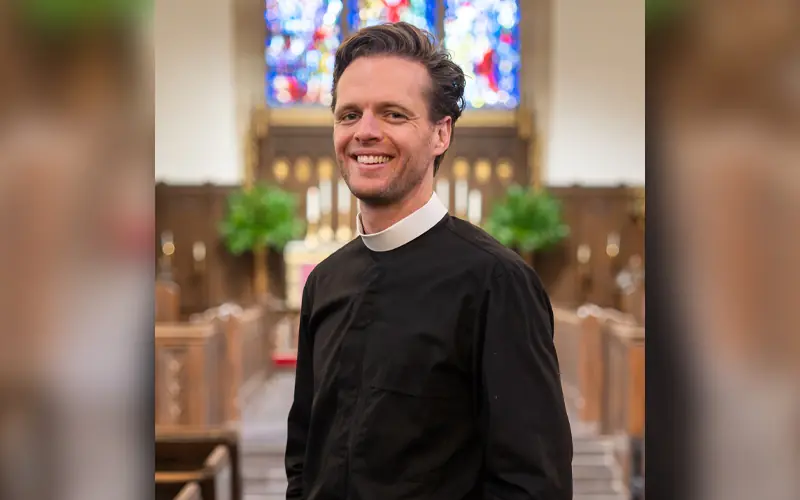
People always want to know about the clerical collar! At best, the collar and the plain black shirt offer a healthy “anonymity” which draws attention away from the priest and their appearance. But it does make the Dallas summers even hotter.
Author