After college, I took a deep dive into studying art history, later incorporating the insight into my interior design work.
Writing about Dallas architecture, and Preston Hollow in particular, feels remarkably familiar.
Every home has a narrative. Every renovation asks the same question journalists do. What deserves to be preserved? What warrants a new story?
Inspiration from visionaries such as Max Levy and Scott Specht remind me that great architecture isn’t simply about creating something beautiful or new — it’s about recognizing the essence of a place before asking it to reinvent itself.
When, in 1999, during the renovation of 4808 Lakeside Drive, Highland Park builder Nicky Oates asked — with a mixture of amusement and concern — whether I was certain I wanted to keep a collection of fragmented tile salvaged from Florence, Italy alongside the baby-blue Versace tile, I responded without hesitation.
Of course I did.
Perfectly matched materials rarely tell interesting stories. The unexpected conversations between old and new always do.
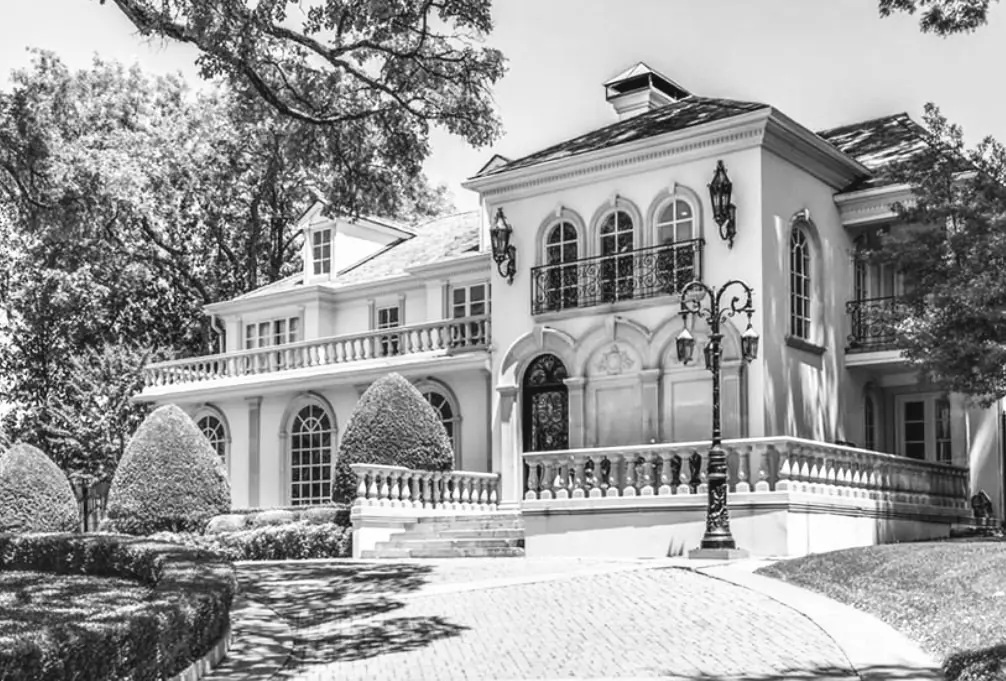
When I undertook the reimagining of 8211 Inwood Road in 2008, my goal was not to erase the land, or the history it had witnessed across generations, but to honor and build upon it.
When one magnificent tree couldn’t be saved, I incorporated its massive trunk into the home’s sculptural staircase. Its story became part of the architecture.
After discovering a pair of salvaged doors from a New York City bank building quietly leaning against a warehouse wall, I knew they deserved more than a storage space.
They soon found a home on Inwood Road — now greeting visitors with the dignity they were always meant to command.
Negotiating for an 18th-century French fountain at a dusty antiques market on the outskirts of Paris in 2017 turned out to be the easy part of the deal.
Convincing customs officials, freight companies, and a parade of logistics experts to shepherd several thousand pounds of carved limestone across the Atlantic proved to be an adventure no travel assignment had prepared me for.
After learning the stained glass windows from The Adolphus Hotel’s penthouse were destined to disappear during a renovation, I did everything short of taking out a second mortgage to rescue them.
I begged. I borrowed. I emptied what was left of my emergency piggy bank.
Because some things simply deserve another chapter.
While my appetite for adventure hasn’t faded, the urge to return from distant places with thousand-pound relics has.
An exception remains.
My quest to recover an original emblem of our family crest recently took me to the crumbling entrance of my mother’s ancestral estate, where the stone carving remains mounted beneath a towering stork’s nest in what was once Germany and is now Poland.
I continue to navigate a delicate balancing act among local government officials, preservation organizations, and neighboring farmers in pursuit of its return.
Journalism taught me that every person has a story worth telling.
Architectural design taught me that buildings do too.
Life has emphasized that some pieces of our heritage aren’t just worth preserving.
They’re worth bringing home.
Author