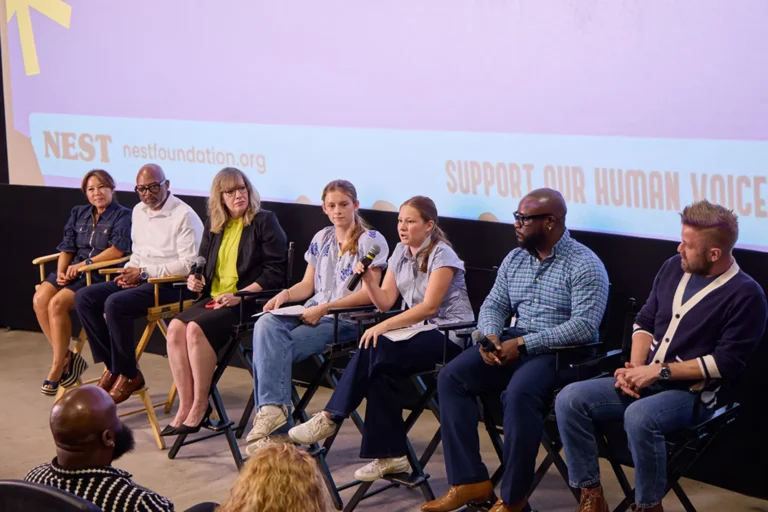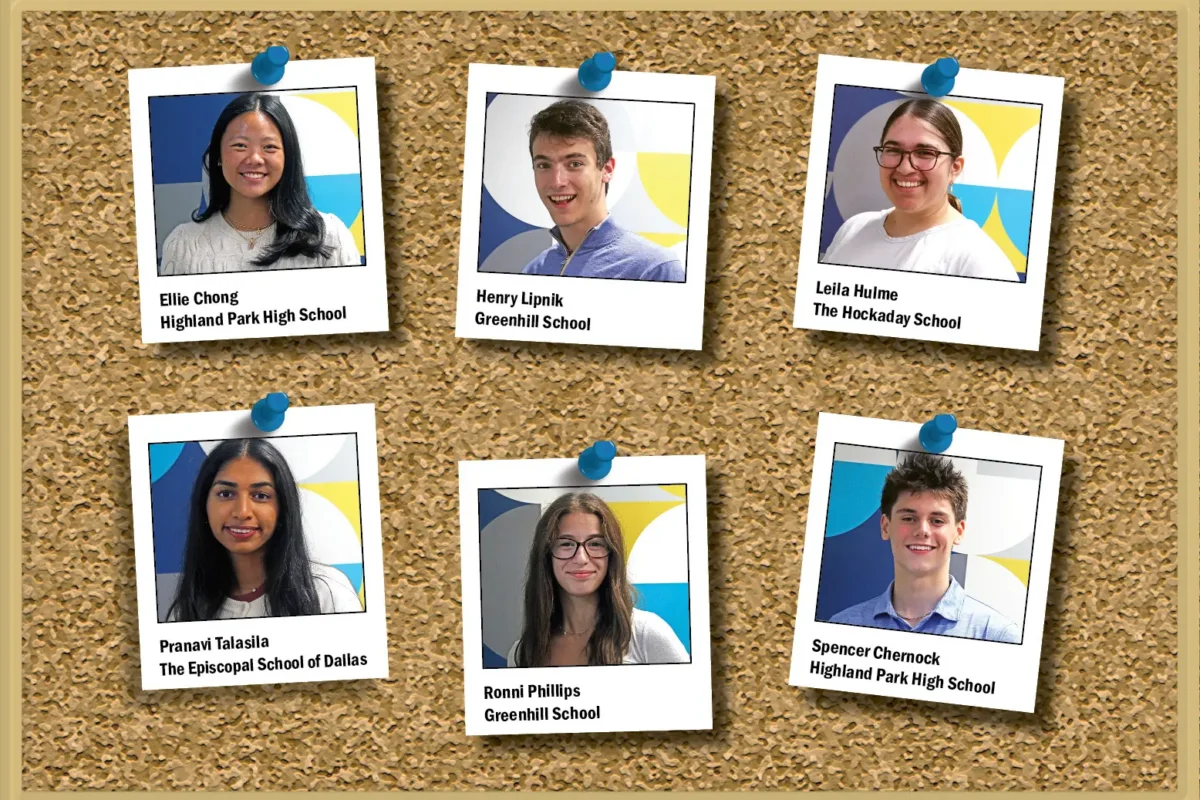
By 2050, today’s high schoolers will be about the age their parents are now, living in a world shaped by the choices being made today. Six high school seniors from schools in the Dallas area gathered to reflect, write, and discuss what life might look like in the future. They considered questions about artificial intelligence, personal autonomy, ethics, humanity, and the direction society is heading.
For the students, who are the generation growing up alongside AI, the future is different from anything generations before could have envisioned.
What follows are lightly edited excerpts from each student’s written response.
In 2050, you will be approximately the age of your parents — what will life look like for you then?
Ellie
In 2050, there will be significant advancement in technology, especially with artificial intelligence, yet along with these greater capabilities comes an increasing need for human connection.
In healthcare, AI will play a significantly larger role in developing personalized diagnoses and treatment plans. Even now, we are starting to develop advanced machine learning models to quickly identify abnormalities. I believe that existing smartwatches and other wearable biotech have the potential of not only tracking sleep and fitness but could be used as indicators for infection and disease. However, I believe that AI will never replace humans in healthcare because humans provide a necessary compassionate element.
Henry
We’ve had the ability, as a society, to do whatever we want. It seems that society hasn’t bound itself by many rules. There’s been unrestrained growth, and I see that really changing in the next 20 years. While we’ve been able to build without care, with the growing threat of climate change and resource scarcity, I think that there will be more regulations as to what actions can be taken. There will be far stronger preventions against pollution and deforestation, and climate impact will be taken with much more care and be of much higher importance than it is now.
Leila
With all of the unknowns surrounding technology, especially the rise of AI, it’s hard to predict for sure what our lives will be like in 2050. I’m afraid that we may end up taking AI to a place where we can no longer control it. But if the people in charge of legislation and policy take the time to recognize both the benefits and drawbacks that AI can have, we could use it to create a real positive change. AI could even act as a “neutral party” in polarized issues, such as feminism, racism, climate change, food, and housing, where no human could be truly an unbiased moderator.
Pranavi
In 2050, I hope life will not be too different from today. Although we can never truly predict the future, I am excited to see what humanity creates. I hope we continue innovating AI in ways we never imagined, using it to help rather than replace humans. The major concern is how anybody can get experience in entry level jobs when AI is eliminating those opportunities. That is why AI regulation is so important. Technology has always shaped society, and I hope that by 2050, we continue to innovate while treating technology as a friend rather than an enemy.
Ronni
Recently, we have witnessed the emergence of AI companies that have grown extremely rapidly and sparked controversy in doing so. As we move past AI’s exciting beginning, even those closely involved, including the CEO of Anthropic, are calling for regulation. There are two possible futures depending on how the legislation is considered now: early limitations that maintain the status quo, or fewer limitations that may allow us to experience why experts believe regulation is necessary.
Spencer
The advent of artificial intelligence will give people more free time. Humanity has always progressed in culture when given free time. Caveman did this by painting buffaloes in caves on rainy days. With a greater amount of free time in 2050, who knows what the next iteration of cave paintings may be? I also believe that there will be new technologies that act as an extension of the body. Think about it, you take your phone everywhere, it’s practically already a part of your being, and I believe that technologies like this will continue to integrate themselves into our lives.
How do you anticipate AI shaping society by 2050?
Henry
I worry about two interconnected issues. First, a labor surplus, where people can’t find jobs because of AI taking entry-level work, which will increase unemployment and prevent new people from entering industries. Then later, when people haven’t been entering these industries and the people who have experience retire, few people will have the experience to replace them, so we will have an expertise crisis.
Leila
I’m honestly a little afraid of how AI may impact our society by 2050. I worry that we run the risk of losing what makes life special. If the decision is made to let AI keep growing, my only hope is that we restrain it enough to the point where we can still be ourselves, even knowing that we might not live up to what a machine can make. Human culture is richer because of its imperfections. Will we lose that with the expanding role of AI?
Will you have more — or less — autonomy over your life in 2050?
Ellie
In 2050, I think people will have less autonomy over their lives because AI will be used to subconsciously control the decisions humans make. Social media already subconsciously changes the way we think, so as we continue through an age of digital dependence, the videos we see may redefine our values and the standards by which we measure ourselves.
Ronni
I believe that the definition of autonomy will change as the future progresses. As regulations are introduced to prevent catastrophic outcomes involving climate change and human rights, “autonomy” may shift. Instead of larger entities choosing whether to engage with or forgo ethical considerations, individuals may have greater responsibility for deciding whether to engage with these entities and considering their own ethics.
How would you describe the conscience of humanity in 2050?
Pranavi
I believe the conscience of humanity will get better with the improvement of technology and humanity learning more about ourselves and the world around us. It’s difficult to predict how humans will act when given advanced technology. For example, with the incorporation of AI, I can only imagine how we will stop thinking for ourselves and will depend on our devices to think for us. I can only hope that we develop a conscience that harnesses technology for the betterment of society.
Spencer
It feels like people are more polarized than ever. People must become more united in problem solving, and the sphere of care in our society must extend to all humanity. I hope ego is set aside, and there is focus on the betterment of society as a whole.
This article is the second in a series in which high school students share insights about their lives. The article was edited by Highland Park High School’s 2026-2027 Executive Editor of ‘The Bagpipe’ newspaper Hannah Hameed, Editor-in-Chief of ‘The Bagpipe’ Ryaan Khan, The Episcopal School of Dallas 2026–2027 ‘Eagle Edition’ newspaper Co-Editor-in-Chief Lilly Traylor, and The Episcopal School of Dallas 2026–2027 Yearbook (Carillon) Co-Editor-in-Chief Emory Simpson.
Author