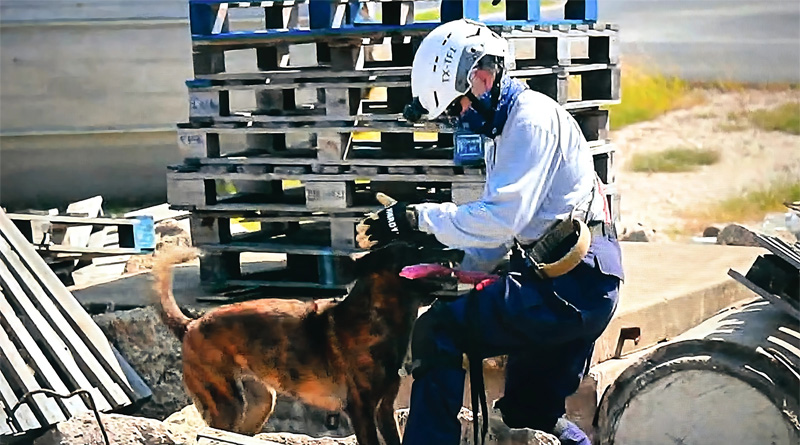
Inside a buried chamber, Christy Bormann hears a bark and feels an immediate sense of relief. Although this time it’s part of a training exercise, the stakes are always high. And for Kaya, a 3-year-old German Shepherd, the mission is always real.
Kaya is one of the elite canines being tested to assist in disaster zones. The rescue team deploys across Texas, including a recent mission to the banks of the Guadalupe River to help locate those missing after the floods.
At Texas A&M’s Disaster City, a mock catastrophe site built to simulate real-life emergency scenarios, search-and-rescue teams train with the intensity of actual deployments.
“These dogs don’t know the difference between a test and the real thing,” said canine handler Tami Stone of the Texas A&M Task Force 1. “When they’re working, it’s all real to them.”
For Bormann and the other team members, canine training involves spending time buried beneath wood beams and tin roofing in a cramped underground chamber. Above her, a layer of debris mimics the aftermath of a building collapse. Only thin slivers of light filter through the wreckage.
For the person trapped below, the environment is suffocating, explained Bormann — for the dogs above ground, it’s a call to action.
When her handler gives the signal, Kaya bolts into the recovery zone, moving with practiced urgency and pinpoint focus — her training turning instinct into action. With a sharp bark — a sound that, in real-life disasters, can mean the difference between life and death — Kaya signals confirmation that a victim has been located.
Nearby, another rescue team member plays the role of a victim in distress. The simulation mimics rising floodwaters and encroaching debris as he waits, trapped in a vehicle. Within just 15 seconds, Kaya locates and pulls him from the vehicle, alerting the surrounding human team.
The canine unit is a cornerstone of Texas A&M Task Force 1’s response capabilities. The dogs’ work often goes unnoticed until a real emergency brings them into the spotlight. Unlike their human counterparts, these dogs rely heavily on their finely tuned senses, often detecting survivors or victims buried beneath rubble, water, or vegetation where sight and sound fail. Their senses proved invaluable during their recent deployment to the Texas Hill Country after flood waters left many lives unaccounted for.
For the team and those they rescue, the dogs are not just helpers — they are the real heroes.
“They are essential,” Bormann said. “They go where we can’t, smell what we never could, and they do it all tirelessly.”
Author