Will C. Beecherl is the mayor of the Town of Highland Park. These are his personal views and do not represent official town policy or positions.
As Highland Park approaches the May 2 special election, where residents will decide whether to continue DART membership, it is important to explain how we arrived at this point and why the town council placed this decision before the voters.
In 1983, the Legislature created funding for DART. The DFW region was smaller, municipal finance was more flexible, and DART was envisioned as the transit system to serve the greater DFW area.
Before DART was created, state law limited cities to a 1% local sales tax. In 1983, the Texas Legislature allowed an additional 1% sales tax to fund DART. Fifteen cities, including Highland Park, opted in to establish DART as an area transit system for its members. The expectation was that the system would evolve and deliver long-term value proportional to the cost.
Between 1989 and 1991, the Legislature reshaped municipal finance in ways that widened the gap between DART cities and those outside the system. Lawmakers expanded cities’ ability to levy additional local sales taxes for economic development and other priorities, up to the state’s 2% cap. Cities that weren’t part of a transit authority could devote that capacity entirely to local uses. DART member cities, having already committed one cent to transit, had limited flexibility. As a result, no new cities have joined DART in four decades, and two original members withdrew, leaving 13 member cities today.
The challenge to grow is compounded by DART’s governance and regional imbalance. DART continues to rely on just 13 member cities, even as the region it purports to serve has expanded far beyond those boundaries. In the next 10 years, North Texas is projected to grow to 10 million.
The 2023 Ernst & Young report shows significant disparities between what some cities contribute and what they receive. In fiscal year 2023, Dallas received service value from DART that equated to 169% of the sales tax it contributed, a $283 million surplus subsidized by other member cities. Compare that to Highland Park, which received service value that equated to only 30% of the sales tax it contributed, and the disparities between “donor” cities like Highland Park and “recipient” cities like Dallas are clear.
In 2025, Highland Park’s sales tax contribution of $8 million was just 1% of DART’s $900 million sales tax revenue, or 0.44% of DART’s full budget. The 2026 projection has Highland Park contributing approximately $9 million in sales tax to DART.
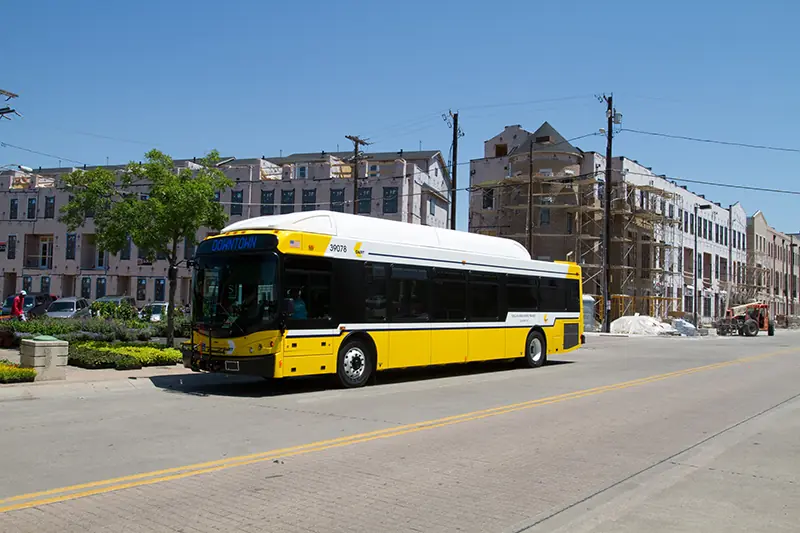
Highland Park has no rail service. Since 2014, three of four bus routes have been removed, leaving a single fixed route along Preston Road that largely duplicates nearby rail service along Central Expressway. According to DART, the remaining route of 66 daily bus trips averages roughly 12,000 annual boardings, or about 33 riders per day.
Sales tax revenue has become critical for cities like Highland Park. In 2019, the state began tightening municipal budgets, whereby Senate Bill 2 capped effective property tax revenue growth at 3.5% without voter approval. For fully developed communities like Highland Park, this cap functions as a de facto salary and service limit, particularly for public safety and an aging infrastructure, leaving sales tax as the only meaningful flexible revenue source. Dedicating half of that capacity to DART significantly constrains our ability to meet essential local needs for town residents.
DART uses third-party providers for its GoLink service. Highland Park is prepared to explore third-party transit providers and other flexible options to meet the modern transportation needs of our residents while maintaining regional connectivity.
After 43 years, the Texas Legislature should consider creating a fully restructured regional transit authority for the greater Dallas-Fort Worth area, supported by an equitable, region-wide funding model.
At the Legislature’s explicit direction, the town council determined that the responsible course of action was to place the decision to remain in or exit DART with voters. The May 2 election ensures the issue is decided openly, locally, and democratically by the residents who, through their elected officials, are accountable for every dollar allocated in the budget.
Rest assured, if the voters choose to exit DART, they can take solace in knowing that Highland Park has played a meaningful role in building a regional transit system, ultimately contributing approximately $150 million.
Author