Highland Park’s Mushroom House may be cooked, but there’s still more on the menu for Preservation Park Cities.
The nonprofit with a mission to preserve and promote the Park Cities’ history, architecture, and traditions is working to increase education about historically and architecturally significant homes.
On March 28, Preservation Park Cities landmarked three homes in recognition of their owners’ efforts to renovate them in a way that maintains their original architectural integrity.
The homes included Peggy and Dan Meyer’s home in the 4400 block of Arcady Avenue, the Sewell’s historic Hal Thomson-designed home in the 4700 block of Drexel Drive, and Kelly and Mark Bunting’s Italian Renaissance-style home in the 3600 block of Beverly Drive, which was designed by Hal Thomson and built in 1923.
Architect Craig Melde of Architexas has also led a team that compiled a register of historic homes in the Park Cities, a process that took about a year. The registry features data, such as dates of construction, architects, and previous owners of note, for about 89 homes. It should be available on Preservation Park Cities’ website in the coming months, said Larry Good, an architect who serves on the Preservation Park Cities Board.
Preservation Park Cities President Jason Morski explained that the registry will also serve as a “record for homeowners if they ever need to do research, if they ever want to do landmarking or any type of deed restriction.”
In addition to the registry, Morski said the organization is partnering with Preservation Dallas on realtor education events.
While landmarking and education encourage efforts to preserve the fabric and history of the Park Cities community, they don’t prevent future renovations — or even a home’s demolition.
“We want some day, some year, for there to be rules in Highland Park and University Park that would govern demolitions and things to help protect these homes,” Good said.
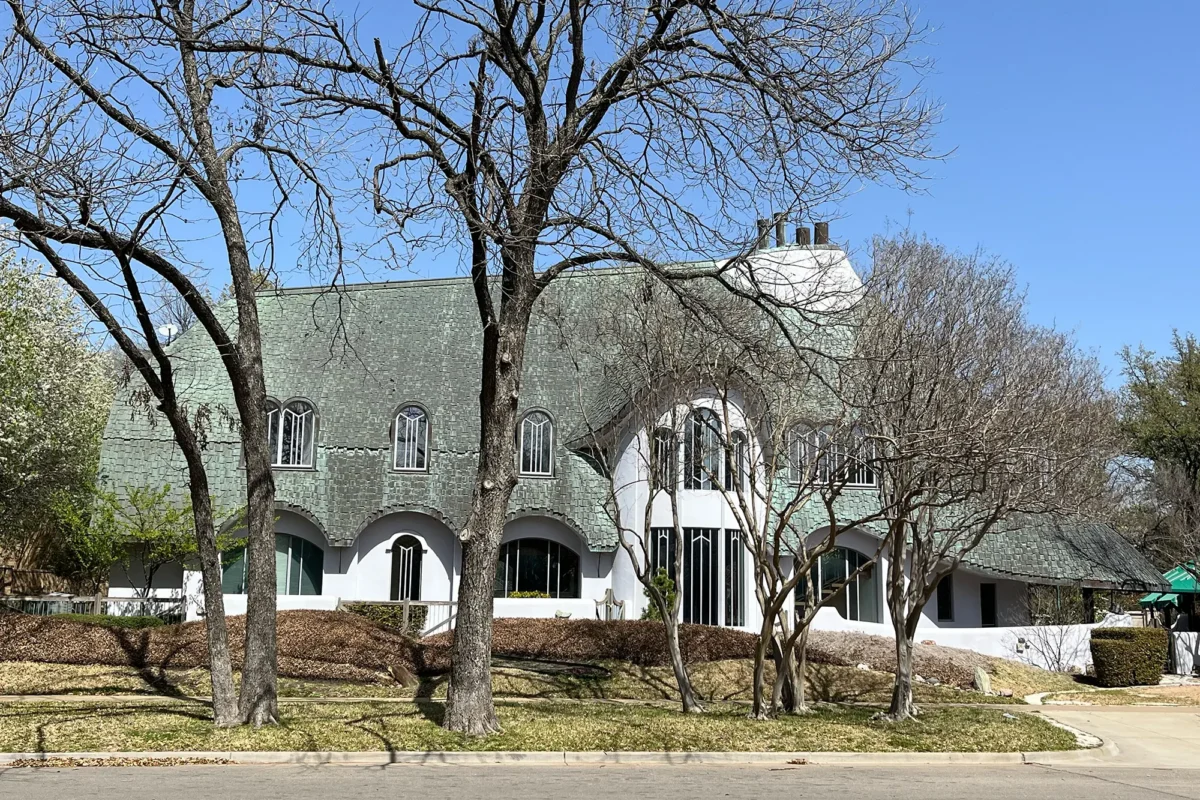
Preservationists were dismayed — but not surprised — by the January demolition of the distinctive Mushroom House near the corner of Armstrong Parkway and Preston Road.
The home was designed to satisfy the unique vision of architect Tom Workman in 1997, but his creation may not have had wide appeal. The home was demolished after its purchase by car dealership magnate Clay Cooley and his wife, Lisa, according to Dallas County Appraisal District records.
“We long ago presumed it would be torn down,” Good said. “We didn’t think Clay (Cooley) would be saving it and, honestly, we didn’t think anybody other than the Workmans would save a house that was so funky and unusual and … like a fairytale.”
Good said he believes that some items from the house, like its copper shingles, cabinetry, and stained glass, should have been preserved. The shingles weren’t saved, but other items from the home were gathered and put up for sale at a consignment shop.
The demise of the Mushroom House was preceded by the demolition of the Cox Mansion, a 1912 Italian Renaissance-style mansion at the corner of Preston Road and Beverly Drive that was formerly owned by the late Edwin L. Cox Sr., for whom SMU’s business school is named.
That mansion, which was designed by Hubbell & Greene Architects, was sold to billionaire banker Andy Beal in 2021. Hubbell & Greene is also known for crafting the Neiman Marcus building and the Arts District Mansion, formerly known as the Belo Mansion.
Author