Homeless cats on the SMU campus have a community of two-legged supporters in their corner.
The Feral Cat Group at SMU has managed and cared for homeless cats on the Hilltop since 2005. Currently, the group tends to approximately 25 cats, but that number fluctuates. The group is supported by funding from the Office of the President and donations, including assistance it receives annually during SMU Giving Day.
The university’s furry residents need year-round helpers, a coordinated effort that requires about 40 volunteers.
“It takes a community,” said Rose Chavez, building manager for the Simmons School of Education and Human Development, who leads the volunteer program. “People either find us online or call us with an emergency, so we have fosters in the wings willing to step up, so we’re very grateful for our team of people.”
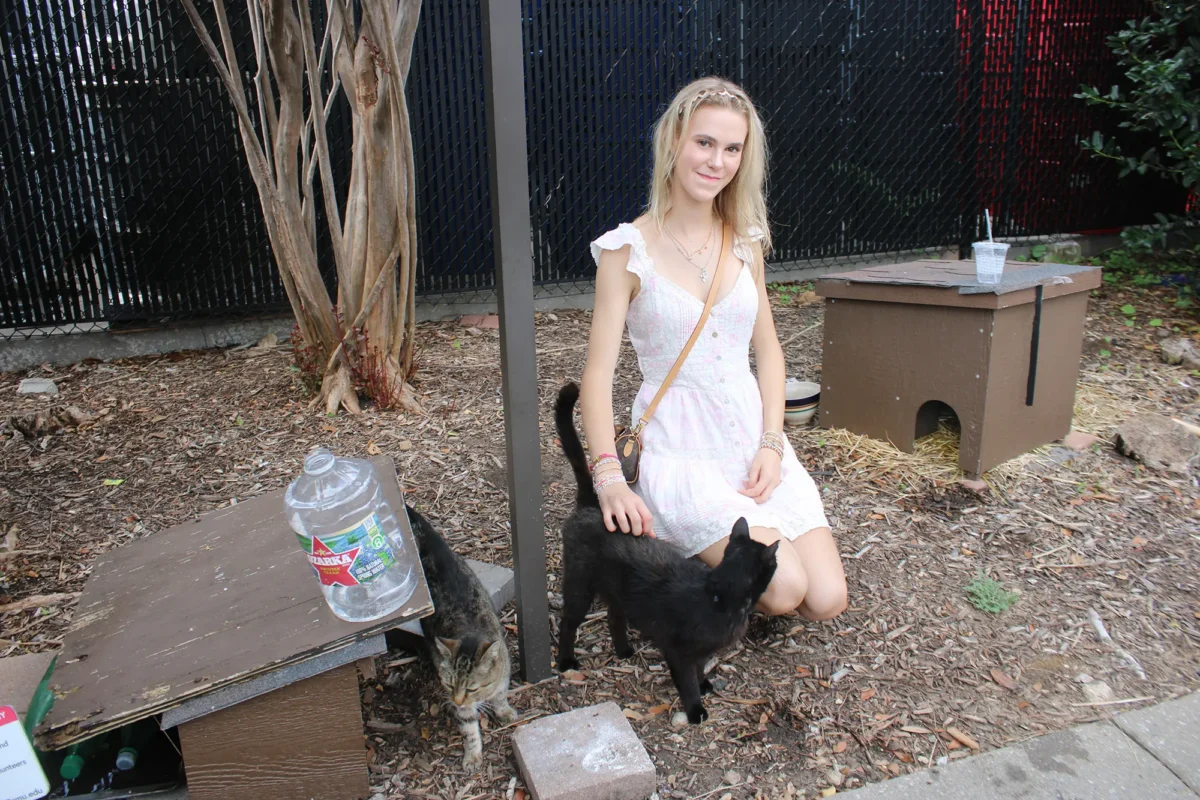
One of those volunteers is Dallas International School senior Estella McFalls.
McFalls, who has a beloved Maine Coon cat of her own at home, decided to use her experience with furry friends to assist animals at her dream school, SMU, after she discovered the Feral Cat Group there via social media.
“I’ve grown up around cats my entire life. I currently have a Maine Coon,” she said. “I was just like, ‘I’d love to be a part of that.’”
McFalls has helped care for the cats around campus since November of last year and also volunteers with Feed My Starving Children.
Aside from the joy of being with furry friends, McFalls’ time spent caring for the cats helps bolster her volunteer hours for school.
Feral cat volunteers clean and refill food and water bowls, which are set up at eight stations around SMU, and treat the stations for bugs as needed. They note their time spent volunteering, the cats’ food and water needs, and any anomalies in the campus cat population, such as new cats joining the colony or any ill animals.
Volunteers apply online and receive training from experienced volunteers before caring for the cats independently.
Volunteers’ efforts have had an impact. The Feral Cat Group has about a 95% spay/neuter/vaccination rate, according to its website. Those efforts have reduced the cat population on campus by almost 50% over the last 10 years.
SMU, along with other universities around the country, utilizes a trap-neuter-return system for managing the campus cat population.
In addition to volunteering with the program or fostering kittens, the Feral Cat Group at SMU also takes donations of money or supplies like cat food, Chavez said.
Author