By Claudia Carson-Habeeb and Grace Conley
When Judy Williamson left The Hockaday School and headed for Ole Miss, she never expected a path that would lead her to become a celebrated photojournalist.
After a breakup with her football-star boyfriend derailed her plans for an Mrs. degree, the New Orleans native made a practical decision that would become the launchpad for a career spanning five continents and decades of storytelling.
Before returning to the city where she’d been a high school boarding student, the college grad submitted a story to The Dallas Morning News travel section. When it was published and a travel writer retired shortly after, Williamson was offered the position.
With only a camera and a Sony Walkman in tow, the fledgling photographer found an ideal way to see the world and get paid doing it.
“I got in at the perfect time,” she said, “before the internet changed it all.”
At the time, she recalled, the public relied on newspapers to learn about breaking news as well as travel destinations, adding that readers wanted stories amplified.
“Our travel section was 24 pages of copy,” recalled Williamson, “It was the period of bigger hair, bigger shoulder pads, and louder music videos. It was such a different world. You’re wearing high heels and hose on airplanes — and you’re smoking.”
During a flight home from a work trip in Europe, Williamson remembered the pilot breaking news about the show Dallas over the intercom. “No one had phones — you found out who shot J.R. from the pilot!”
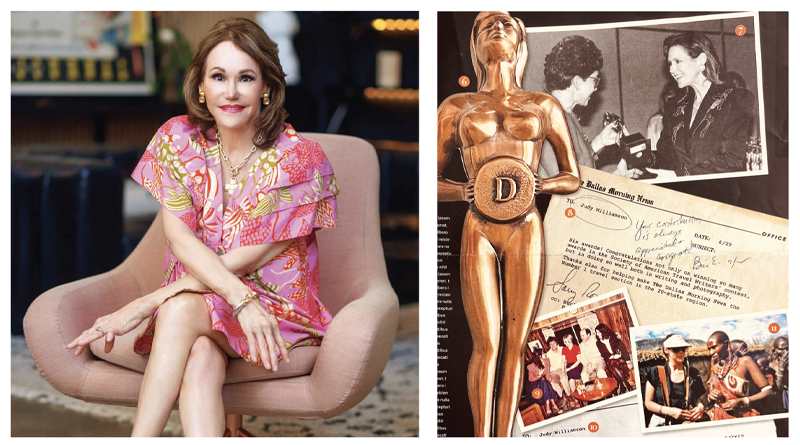
In Paper Girl’s World, a 396-page collection of images, the longtime Park Cities’ resident chronicles the wonder of the world prior to the evolution of the internet.
During the pandemic, Williamson sifted through decades of work — slides, negatives, and published columns, including those from her time as travel editor at the Houston Chronicle — to select what would appear in Paper Girl’s World.
“I have so many wonderful photos of families and children and communities from around the world. We all want the same things — health and safety, laughter and love,” she said. “I went with the strongest photos and my favorite trips.”
One standout trip was to Kenya, where she recalled the breathtaking landscapes that made for “rosier sunrises and sunsets” — the series earning her a Katie Award for Best Specialty Writing.
In Kenya, the Imbirikani Girls High School left a lasting impression on Williamson — the young women’s determination to fight for their education reminding the photojournalist of her own opportunities at The Hockaday School.
“Hopefully, the proceeds from the book will be enough that I can pay for scholarships for these girls,” she said, adding that her parish at Highland Park Presbyterian Church also sponsors students at the school.
Williamson hopes her book captures the magic of travel unmediated by screens.
“There’s not one photo in the book of someone with a cell phone. That was the ’80s and early ’90s — people at cafés were talking to each other. It’s a reminder to look up, not down,” she said, “and that the world really is a wonderful place.”
Author