Counselor offers parents guidance
As the community mourns those impacted by Texas Hill Country floods, strength found in shared sorrow and the deep compassion rising from it endures. In the aftermath of a tragedy, many families struggle to find the right words for their children.
The Park Counseling’s Jennifer Kennedy, a licensed professional counselor with more than 25 years of experience working with children and pre-teens, emphasizes the importance of open, age-appropriate conversations.
She offered the following guidance for parents navigating the complexities of helping their children cope with grief and loss.
How do children of different ages typically process grief and loss?
Grief affects children differently depending on their age and developmental stage. One common response across all ages, especially after a sudden or traumatic loss, is brain fog. The brain and body are working overtime to process what happened, making it hard to answer simple questions or make decisions.
Neighborhood Spotlight
Preston Hollow
Young Children (Ages 5 and under): Grieve primarily through play. They may reenact the loss or elements of it in their play, which is normal and healthy. Adults can support them by joining their play gently and being present.
Early Elementary (Ages 6–9): These children are beginning to grasp the concept of death but may not understand its permanence. Grief often shows up in intense emotional outbursts — like anger or sadness over everyday tasks (e.g., taking a bath or eating a snack.) They may express big feelings in short, sudden bursts. Kids grieve in the middle of daily life; it takes them by surprise and parents too.
Preteens (Ages 10–12): Understand that death is permanent and inevitable. They may feel sadness, anger, guilt, or fear and often need help naming and expressing those emotions. Their grief may look more internal and reflective.
Teenagers: Teens fully understand death but may suppress their grief or express it through risk-taking, withdrawal, or intense emotional swings. Connection with peers is especially important at this stage — teens may open up more in group settings or when talking with friends. This can be challenging if they are scattered from the friends that also experienced the grief event. Try to find ways to help them connect. Older teens may also feel pressure to support grieving adults, which can cause them to hold back their own feelings. Parents should model emotional regulation and self-care, so teens don’t feel like they need to “take care” of them.
Is it OK to let them attend vigils or memorial services if they ask to?
Absolutely. If a child asks to attend a memorial service or vigil, it’s OK to let them. If they don’t want to go, that’s also OK. Children have an intuitive sense of what they need. Parents sometimes worry about doing the “right” thing, but with a grieving child, there isn’t one right way. The most important thing is to meet them where they are, moment by moment.
What should parents do if their child doesn’t want to talk about it at all?
If a child isn’t ready to talk, the best approach is to be patient and gently present. Let them know you’re available without pressuring them to open up. Staying emotionally available and connected, even in silence, helps them feel safe.
Some kids process grief better through activity. Try going for a walk, shooting hoops, or cooking together — these can offer safe spaces for expression without the pressure of direct conversation. If they’re quiet, acknowledge it with empathy: “I know you’re not ready to talk, and that’s OK. I’m here when you are.”
How can parents check in with their child over time without pushing too much?
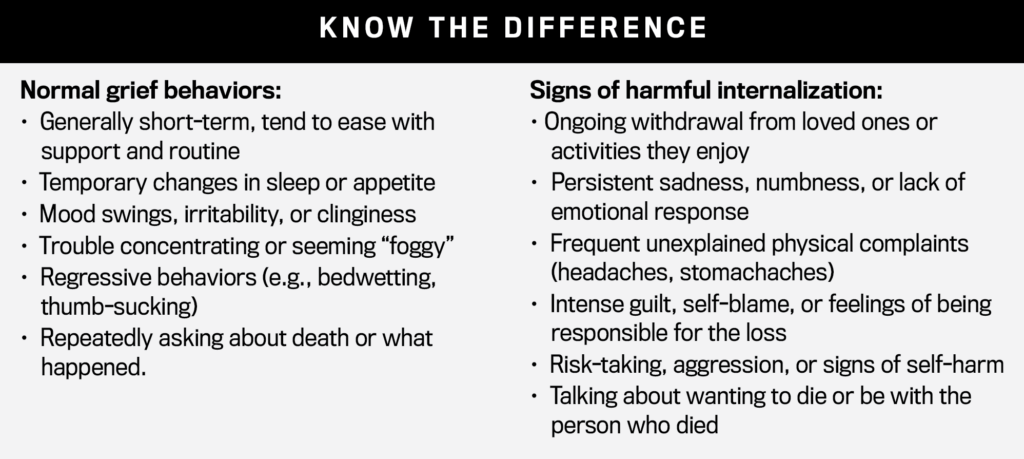
Kids often communicate through behavior more than words. Watch for changes in their body language, expressions, eating, and sleeping patterns. If something seems off, gently name it: “You seem a little quiet today — just know I’m here if you want to talk.”
For older children or teens, you can ask about how their friends are coping — this often prompts them to share about themselves more comfortably. Also, remember to:
• Validate all emotions, including confusion or numbness.
• Revisit the topic periodically — grief isn’t linear, and feelings can resurface or evolve.
• The goal is to stay emotionally available and connected over time.