I descend from a long line of people who understand that citizenship carries obligations beyond private comfort.
On my father’s side, the ethic was conveyed quietly. My paternal grandparents never met a stranger, practiced conciliation as instinct, and led with decency rather than dominance. They believed that dignity disarmed hostility and that neighborliness itself constituted moral action.
From my mother’s lineage came a resolute spirit. My maternal grandmother, a countess, carried her title with a fierce sense of noblesse oblige. Her impeccable sense of etiquette accompanied her gift for puncturing hypocrisy and arrogance with measured corrections. When confronted with disingenuous rhetoric or mean-spirited behavior, she did not hide behind pedigree.
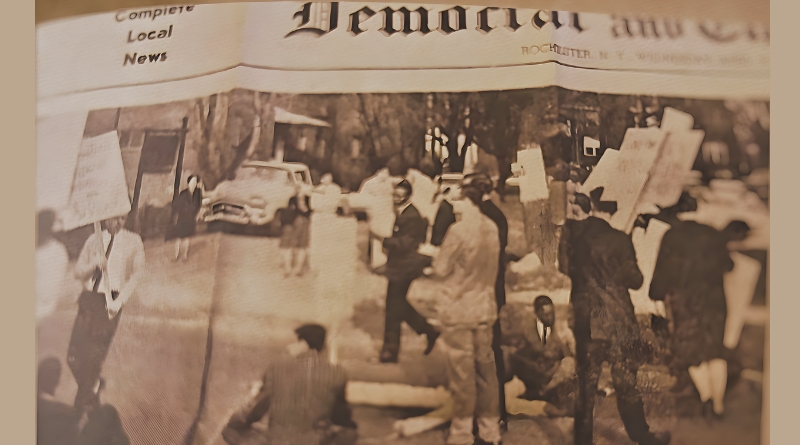
As a young girl, I discovered a time-worn newspaper clipping in a family photo album — a story unfolding that transformed abstraction into inheritance. In an accompanying photograph, the bearded demonstrator bore an unmistakable resemblance to my dad.
“In the spring of 1964, a Black woman, Marie Fitzhugh, with a master’s degree in social psychology, started her own clinic,” wrote essayist Bob Nelson. When she tried to rent an apartment, “landlord after landlord refused,” he recalled — my father’s classmate at Colgate Rochester Divinity School illustrating how equally qualified professionals faced housing barriers based on skin tone alone.
Nelson described a group of seminarians, including my father, who stood against the discrimination. They peacefully organized a protest, only to be loaded into paddy wagons and fined $50 each. This act of civil disobedience was just one of many causes my father championed, guided by engagement rather than applause throughout his acclaimed life’s work.
That memory resurfaced recently when I attended the Dallas ISD Martin Luther King Jr. Oratory Competition. As each elementary-age student stepped forward articulating a vision shaped by history yet oriented in youthful perspective, possibility abounded. Their speeches were poetic, powerful, hopeful. Notably absent was anger, judgment, or contrived conflict.
Fourth-grader Cameron Kinder, a not-yet-decade-old orator and the competition’s second-place winner, stood before the audience with a wisdom beyond his years. Reflecting Dr. King’s call for moral courage rooted in empathy, he quoted, “There comes a time when one must take a position … because his conscience tells him its right.”
As I tried to inch inconspicuously toward the stage to capture photos for our publication, a fellow mom stopped me, asking, “Which one of those babies up there is yours?”
“All of them,” I replied, as she gently wiped away the renegade tear I’d held at bay until that moment.
In that instant, a throughline became unmistakable to me — grandparents practicing decency, seminarians standing up against unfairness, and children choosing principle.
History advances through defining moments, yet its endurance depends on the quieter decisions made every day. The legacies I witness, both inherited and renewed, serve as a reminder that standing up does not always require shouting. Often, it begins with showing up, speaking plainly, and trusting our conscience to lead.
Author