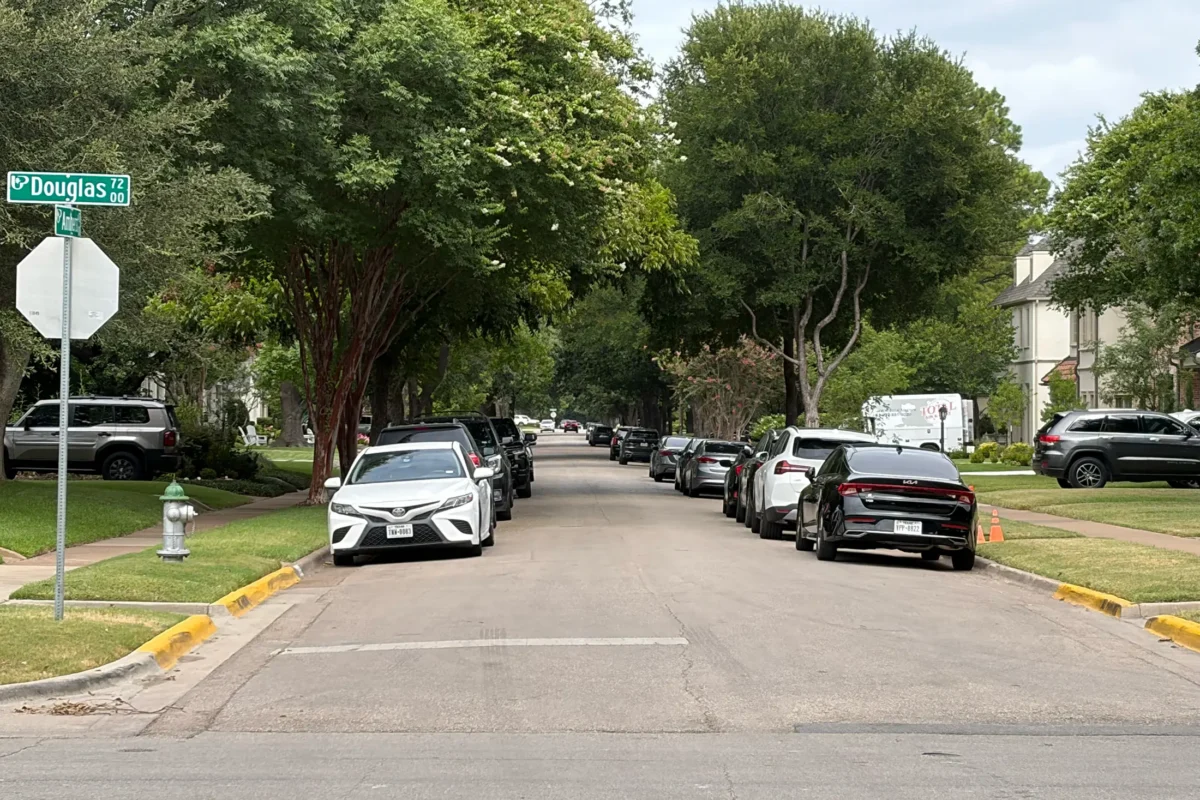
Parking problems have long driven University Park residents in some high traffic areas to the brink. Neighbors can’t find a spot in front of their homes or see when they back out of their driveways. Residents say a pet has been run over. Cars have been dinged.
Since 2002, University Park has created resident-only parking districts for 2,000 addresses on 1,511 parcels of property. Typically, the city considers parking limitations after receiving a resident request and surveying the affected block to determine whether a majority favors limited parking.
If the majority agrees, the issue is presented to the city council for approval, explained community information officer Paige Ruedy.
During council meetings, residents have said that their overcrowded streets create safety issues.
“We’ve seen cars hit. We’ve seen people almost hit. We’ve seen all kinds of accidents,” homeowner Charles Bufkin told the council in April 2024, when it approved a resident-only parking district in the 4300 and 4400 blocks of Amherst Avenue.
While some drivers were careful on his narrow block, others hurried through it, resident Greg Crespi told the council in July when it voted to restrict parking on a portion of the 4200 block of Amherst Avenue.
“Over about the last five or six years, the number of cars and trucks that have parked on our block has steadily increased,” he said, adding that one cat had been run over, and cars had been clipped.
Between Aug. 1, 2025, and July 31, 2026, the city issued 2,708 citations for residential parking district violations, according to Ruedy.
But some University Park city council members have suggested it may be time to put the brakes on residential parking restrictions. Enforcement costs the city more than $87,000 annually, not including costs that do not recur on a yearly basis, according to Ruedy.
Council members have questioned that expense and whether the districts are the best way to solve parking problems.
During the July 21 city council meeting, Mayor Pro Tem Phillip Philbin seemed skeptical of a restriction on part of the 4200 block of Amherst Avenue. He asked staff whether the parking issue would simply commute one block north.
“Most likely it will,” responded director of public works Keegan Littrell. “But then, how far north does it continue to push?”
The council voted 4-1 in favor of creating the resident-only parking district, with Philbin as the lone dissenter.
In August, the 4200 block of Amherst Avenue came before the city council a second time. One home had asked to be added to the district, while another wanted out.
“The proposal is that it would now zigzag across two houses,” Rieman said. “We’re individually privatizing people that want specific, individual parking restrictions.”
“Do we have any other residential parking districts that have, for lack of a more technical term, a zigzag in the middle of them?” asked council member Darrell Lane.
The council voted 4-1 to deny the request. Mayor Pro Tem Philbin dissented a second time, explaining that he believed the city should remove the district entirely.
“I’m concerned that this is more tax and spend. Just last night, we proposed a raise in taxes to do parking enforcement,” Philbin said before the vote, referring to the city’s November tax rate election, which would in part fund technology for residential parking districts. “If we don’t have the money to do parking enforcement at Snider Plaza, we certainly don’t have the money to do parking enforcement on private streets like this.”
Author