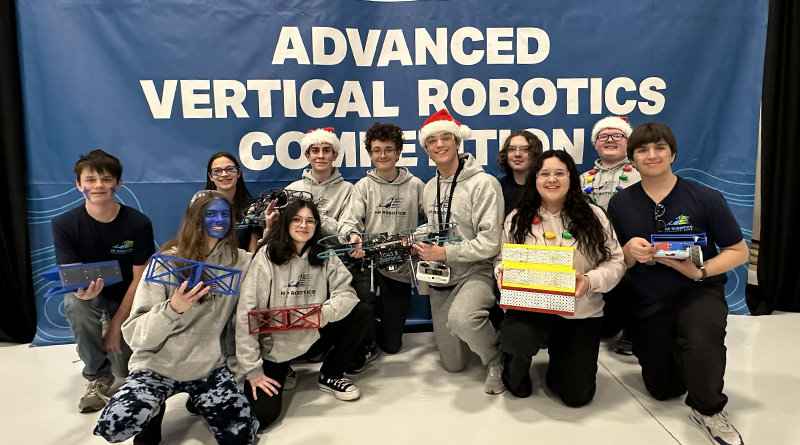
Highland Park High School’s robotics team is flying high after its stellar performance at a national championship and insider’s tour of SpaceX.
Team members brought home third and fourth place in the 2024 Advanced Vertical Robotics Championship, which challenges students to complete a real-world mission using multiple drones and robotics vehicles that they design, program, and pilot themselves.
Last year’s finish was the best performance ever for Highland Park, which was in only its fourth year competing in Advanced Vertical Robotics. HP has been steadily climbing in the team standings since its start in 2021.
“I don’t want to jinx us,” coach Timothy Thomas said. “We think we may have a good chance of winning everything this year.”
Thomas attributed the team’s success to a community effort from its booster club, HPHS Principal Kevin Hunt, and the dedicated, creative students who worked on their drones for long hours, and even gave up their Saturdays to continue perfecting their designs.
“We’re not on the par of football, because everything in Texas is football,” Thomas said. “But there are other ways to show your passion, and your ability to accomplish great tasks with hard work.”
Neighborhood Spotlight
Park Cities
Where the Park Cities Stay Connected.
Last year’s robotics students were divided into two teams, Zephyrus, which placed fourth in the championship, and Electronic Dysfunction, which finished in third place and snagged the Best Overall Design Award.
Hudson Tinch, who co-captained Zephyrus, said team members collaborated well, were prepared, and were able to adapt to last-minute challenges. In one round of competition, the team jerry-rigged a successful invention with part of a pizza box, duct tape, and a screwdriver.
Both teams worked to simplify their designs. The members of Electronic Dysfunction minimized their number of moving components, and reduced their drone’s weight by eliminating or replacing some non-essential parts.
“It’s all about efficiency,” said Efekan Koral, who was one of Electronic Dysfunction’s captains. The changes meant the team’s design was less prone to failure, and that the team never had to use the air bag system that would deploy if its drone crashed.
HP students saw their no-frills approach employed on a much larger scale during their April visit to SpaceX.
“Everything had a purpose,” Tinch said, “and it wasn’t overly complicated just for the sake of being overly complicated.”
The students toured SpaceX’s entire production facility near Brownsville, Texas, and learned how its unique rockets are made.
Ashley Schumacher, who co-captained Zephyrus with Tinch, said she was impressed by the sheer size of SpaceX, as well as by the amount of manpower that goes into creating its rockets. Because SpaceX continues to innovate, automation can’t keep up and most work is done by people as opposed to machines.
“You see rockets on TVs and social media, and you think, ‘oh yeah, they’re big, but they’re not that big,’” she said. “But when you’re next to them and they’re 400 feet tall, it’s pretty crazy.”
The SpaceX tour aimed to build students’ excitement about the sciences, and showed them what they can accomplish when they combine hard work with excellent problem solving, communication, and time management strategies, Thomas said.
“This is not just about winning an award,” he explained. “This is about developing skills and behaviors that could benefit you, regardless of what you choose to do as a profession.”