
As SMU continues to grow, university leadership will work to foster partnerships with organizations across Dallas in hopes of becoming a research and innovation engine in the region — something like what Stanford University is to Silicon Valley.
“There are interesting questions there to think about how do we connect to Dallas in a research sense. One of the clearest examples in academia is you think about that relationship between Silicon Valley or Palo Alto and Stanford,” SMU President Jay Hartzell said at his first state of the university address. “I would argue that Dallas needs us or at least we can benefit Dallas.”
As for how SMU can benefit Dallas, Hartzell said SMU provides “an ability to work together to discover what the big needs are and how can we address them together. We bring the scholars to the problem, and we also have a way to convene people from different sectors together in a way that I think is special.”
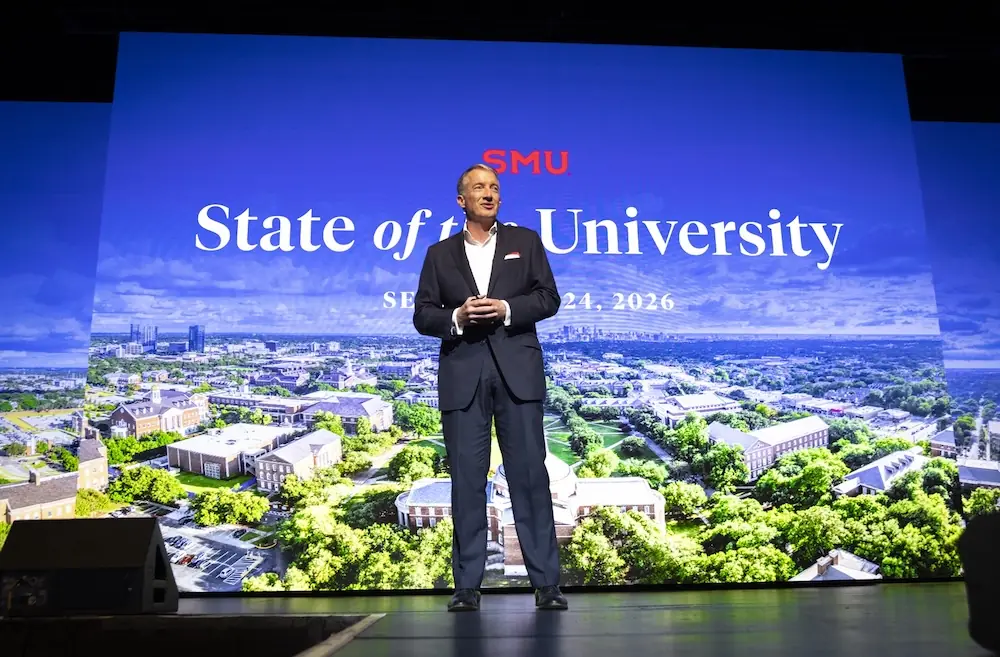
Hartzell, formerly president of the University of Texas, took over leadership of the university last year after R. Gerald Turner concluded his 30 years as SMU’s president, and laid out his vision for SMU’s future at the state of the university address Sept. 24.
In the spirit of partnership and strengthening connections between the university and the region, SMU recently formed the Dallas Office led by former Klyde Warren Park CEO Kit Sawers, and is partnering with the George W. Bush Presidential Center on a new course and undergraduate minor exploring leadership. Hartzell also said he hopes the university’s planned expansion across U.S. 75 and relocation of the Dedman School of Law will create more opportunities for research, innovation, and collaboration with the community.
“A cornerstone of our strategic plan, expansion at the Eastern Edge will create a new destination for law, business, entrepreneurship and applied research,” Hartzell said. “It will be a place where discovery meets application. Where scholars collaborate with industry leaders. Where entrepreneurs test new ideas. And where students gain hands-on experience addressing complex issues.”
Other initiatives Hartzell discussed include launching more signature academic programs, an enterprise partnership with Anthropic to utilize Claude and integrate AI learning, and reimagining and moving the Hegi Family Career Development Center within the Office of the Provost to further integrate career development through the academic programs.
“The strength of this community is why I am so optimistic and confident,” Hartzell added. “This year, SMU welcomed the largest and most accomplished incoming class in our history. We have recruited more than 70 remarkable new faculty to the Hilltop, many of whom chose SMU over highly ranked institutions. And we recently announced a $25 million project with the U.S. Department of Energy and industry partners to advance critical minerals technology, which represents the largest individual research funding commitment in SMU history. More people across the country are discovering what we already know: There is something special happening on the Hilltop.”