Math may be a useful skill, but it doesn’t usually make for compelling reading.
That is, unless you’re browsing articles on Youth Stemline, a website created by students at Greenhill School and The Hockaday School for peers to express their interests in math, science, and technology.
The website’s environment section includes one piece titled “Cow Farts, Climate Change, and Coffee: The Unexpected Connection.” Other writings cover everything from the digitalization of beauty standards to space-time and NASA’s Artemis II mission.
“I think one misconception is, ‘these articles are written by teenagers. How good can they be?’ That’s something we work to break,” said editor-in-chief Aravli Paliwal. “A lot of the work that our writers put out there is quality work.”
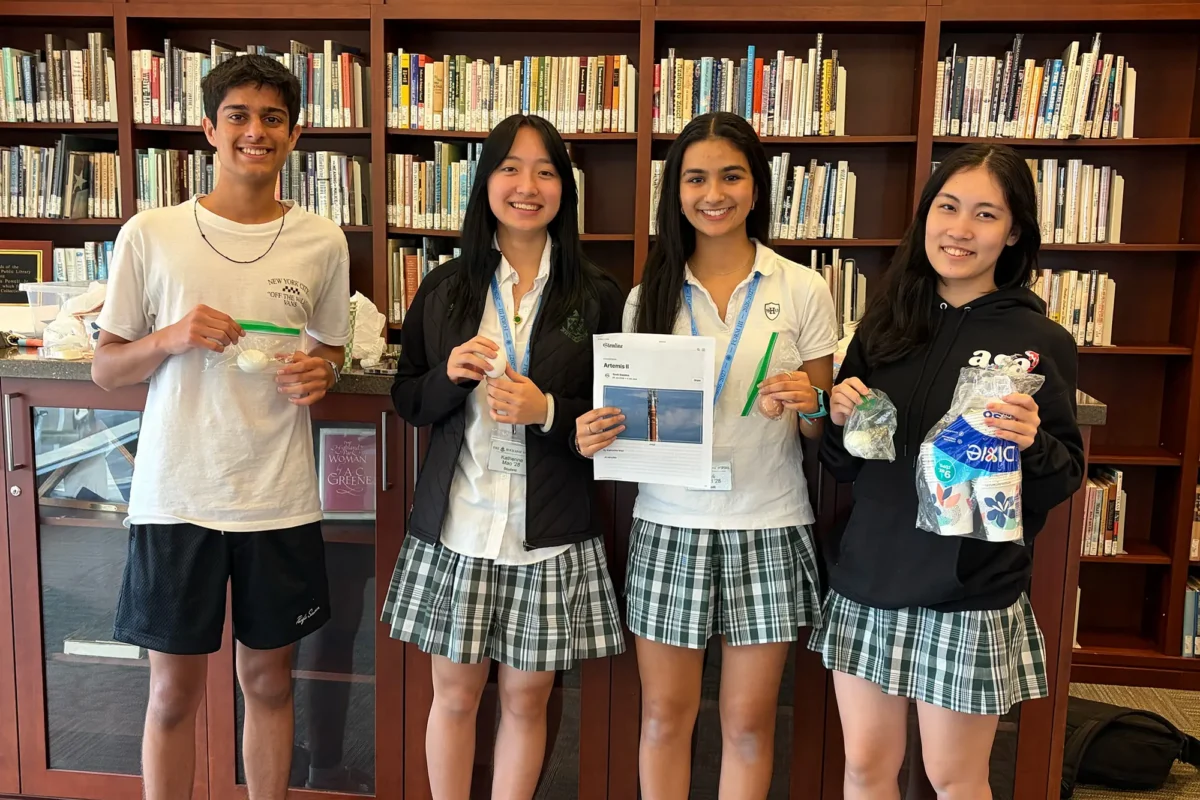
Paliwal, a junior at Hockaday, founded Youth Stemline in the summer of 2025 with Greenhill student Ronak Ramnani and fellow Hockaday students Katherine Mao and Ariel Yuan.
Since its creation, the website has grown to include more than 40 writers. And the group’s founders have taken their desire to spark an interest in STEM off the page and into the community.
They’ve hosted a series of TomorrowMakers workshops for young learners in partnership with the Dallas Police Association, the Preston Royal branch of the Dallas Public Library, and the University Park Public Library. Topics have included wacky weather, artificial intelligence, and why airplanes don’t fall out of the sky.
The teens have endeavored to create interactive experiences for workshop attendees.
“There’s only so much impact you can have when you’re online,” Ramnani explained. “Not everyone’s reading our articles.”
About 15 children crowded into a conference room at the University Park Public Library for a Wednesday afternoon session on outer space.
The members of Youth Stemline began by sharing information about gravity and the solar system before breaking their listeners into groups to tackle a hands-on challenge: how to cushion spacecrafts, or hard-boiled eggs, from the force of landing on distant planets, or being dropped from the library’s balcony.
Not all the spacecrafts touched down safely, but the members of Youth Stemline reassured rookie scientists that cracked eggs didn’t mean that their designs weren’t successful.
“This is what lots of scientists go through,” Paliwal said. “They go through lots of failure before they even get one good result.”
The session, which ended with discussion questions on a Youth Stemline article modified for a younger audience, was also a touchdown for parents.
“I think it’s great that even though they’re still young, and have not graduated high school, they’re pouring into the younger generation,” said Belinda Alexander, who brought her children to the session. “I feel like kids learn from other kids, too. They pay attention. It shows that they can do it when they’re older.”
The founders of Youth Stemline, who are all now high school juniors, hope the program continues to grow. They’ve spread word about their project to other teens who have started chapters in the United Kingdom and Kazakhstan.
“We want people who are sophomores, freshmen, and even younger than that to see what we do, and then take the foundations that we’ve built, and add their own tweak,” Paliwal said. “We don’t want this to stop when we leave.”
Author