From harvesting honey to drafting woodworking plans, the STEAM curriculum at Preston Hollow schools is buzzing with innovation. Blending hands-on learning with core academics, dynamic programs have grown into ways for science, technology, engineering, arts, and math to intersect in unexpected ways. Students aren’t just reading about ecosystems — they’re tending school beehives. They aren’t only studying geometry — they’re applying it to design and building real, tangible items.
Teachers are demonstrating how this expanded approach encourages curiosity, confidence, and problem-solving, giving students a chance to see how classroom concepts come alive in the world around them.
In this special STEAM edition, we take a closer look at the projects shaping young minds, the educators guiding them, and the community partnerships helping these programs thrive. Together, they’re redefining what learning can look like — and proving that creativity and innovation grow best when students are allowed to build, explore, and get their hands a little sticky.
Ursuline Academy‘s all-girls team breaks barriers in robotics
At Ursuline Academy of Dallas, students are taking charge of technology in the robotics lab and the physics classroom.
From an all-girls robotics team competing in a male-dominated field, to a hybrid AP Physics C course designed to keep top STEM students challenged, young women are redefining what innovation looks like in education.
After the official “game reveal” in the fall, Team Robovinia began designing, building, and coding their robot. The model featured an advanced drive train, a specialized intake system, and an evolving webcam-based navigation system that used AprilTags for autonomous movement.
On Nov. 22, in the FIRST Tech Challenge, Robovinia debuted a fully student-built robot designed to launch and retrieve game pieces.
Out of 34 teams in their league, only two others were all-girl teams — a powerful reminder that the future of engineering isn’t limited by gender.
Ursuline students also collaborated with Jesuit Dallas for coding mentorship and lab support, diving into Java programming and other technical skills that pushed forward their engineering knowledge.
With their sights set on the 2026 regionals and nationals, the 10 core members met after school and on weekends to perfect their mission.
Ursuline’s commitment to empower young women in STEM was also sparked when the school’s AP Physics C teacher left last summer. Rather than canceling the class, Ursuline launched a one-year, hybrid version of the course, led by Barbara Watson, one of the region’s most respected AP Physics instructors.
Students completed asynchronous lessons during the school day, gathered each Tuesday evening for in-person instruction, and came together once a month for immersive lab sessions while building projects that included homopolar motors to make abstract physics concepts come alive.
Parish Episcopal drives innovation across STEM and the arts
Parish Episcopal School expanded its hands-on, interdisciplinary learning to connect STEM with the arts and real-world problem-solving.
This fall, students engaged directly with design, sustainability, and innovation across all grade levels.
Parish’s STEM, Arts, and Center for College & Life Planning departments partnered with the Communications team to host students from the Savannah College of Art and Design (SCAD).
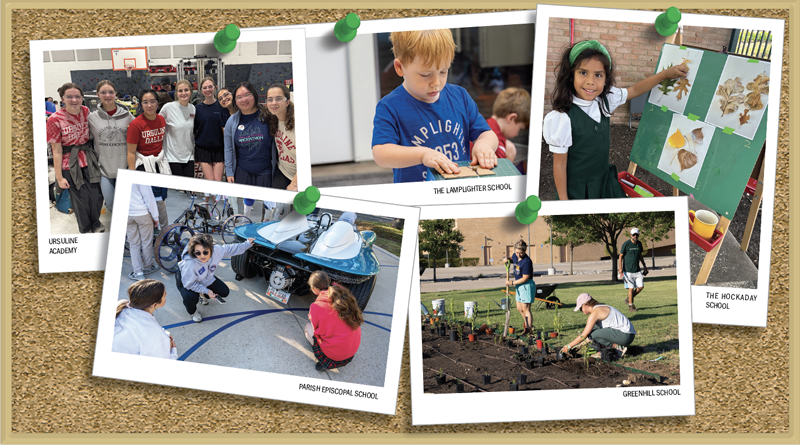
Members of the SCAD team showcased their award-winning electric vehicle concept car and discussed their design process with Lower, Middle, and Upper School students. Parish’s NASA Human Exploration Rover Challenge (HERC) team joined the event for a friendly test run between its Rover and the SCAD car, exchanging insights on engineering and creativity.
At the Hillcrest campus, the first phase of the Nauslar Family Garden renovation was completed this fall, featuring 16 raised VegoGarden beds with in-bed worm composters, a new garden shed, and an outdoor wash station. The expanded space supports outdoor, cross-curricular learning opportunities where younger students will enjoy their first vegetable harvest later this season.
The trimester concluded with the November Parish STEM Showcase, where families celebrated student work from the fall. Highlights included a CO₂ dragster race sponsored by the sySTEMs booster club, along with exhibits such as 3D-printed designs, Makey Makey projects, circuits, and new Rover prototypes.
The Lamplighter School’s woodworking program crafts real skills
At Lamplighter, woodworking is more than a class — it’s a hallmark of hands-on learning and creative exploration.
Reflecting the school’s mission to nurture curiosity through engaging, collaborative experiences, Lamplighter’s woodworking program invites students to imagine, design, and build with both traditional and modern tools.
Beginning in pre-K, children are introduced to the basics of design and construction using storybooks, 3D-printed manipulatives, and simple tools. As students progress through the Lower School, their skills and confidence grow alongside the complexity of their projects.
By third and fourth grade, young makers are drafting plans, keeping design journals, and mastering tools ranging from hand saws and kid-safe chomp saws to laser cutters and 3D printers.
Through every stage, students experience the joy of turning ideas into tangible creations — learning persistence, precision, and the power of imagination along the way.
Greenhill School’s environmental impact reaches far and wide
Greenhill’s comprehensive environmental science education initiative focuses on the best practices for environmental stewardship, incorporating the local Blackland Prairie ecosystem and vegetable gardening with hands-on learning.
The program aims to serve as a model for other schools nationwide and worldwide, providing professional development training in ecosystem restoration.
Greenhill received a $100,000 matching grant from the Edward E. Ford Foundation to establish an environmental science education program, including the construction of a greenhouse, Blackland Prairie ecosystem installation, and outdoor learning spaces for pre-K-12th grade. The school is raising $100,000 to receive matching funds from the foundation.
360-degree learning guides Hockaday’s exploration
Hockaday’s First Grade Field Studies, an interdisciplinary class that combines art, science, writing, and math, enables students to spend most of their class period outside, observing nature and recording their findings in journals.
The class reimagines what it means to engage young learners through hands-on, interdisciplinary exploration.
“I want this class to stimulate the whole learner,” said instructor Emily Dutcher. “I believe in 360-degree learning — learning that synthesizes everything else our girls are doing in their other classrooms. Nature provides an engaging, hands-on backdrop for them to begin making meaningful connections between their learning and the real world.”
The class explores projects such as turning food waste into natural dyes for weaving projects, partnering with the Upper School’s AP Science to map the Blackland Prairie area on campus, and harvesting honey from Hockaday’s campus beehive.
While students make a catalog of native prairie trees on campus, using math concepts to organize and compare them, they learn about botanist and photographer Anna Atkins and her cyanotype process to document their findings.
Working with Dr. Sarah Kucker and researchers from SMU’s Kids in Development Lab from SMU’s Dedman College of Humanities and Sciences, Dutcher is seeking to better understand how the non-traditional approach to learning supports Lower School outcomes, including wonder, collaboration, resilience, and agency.
“I believe that giving students access to this type of learning will make them better thinkers and learners overall,” she said.
Author