Private speech therapy can cost $100 an hour or more, and a critical scarcity of speech-language pathologists means that it can be difficult for some families to access care at all.
But what if parents and speech pathologists had an artificial intelligence tool able to model correct speech for children who stutter or have speech impediments, one that maximizes learning by reproducing a child’s speech in that child’s original voice?
Thanks to the work of Highland Park High School junior Ethan Li, they may soon. Li was inspired by his own struggles to be understood as a young Chinese speaker to create SpeakWise, an AI tool designed just for children that would be free, fast, and easy to use.
“I hope it can help people,” Li said. “But I also hope it can inspire other people to try to help.”

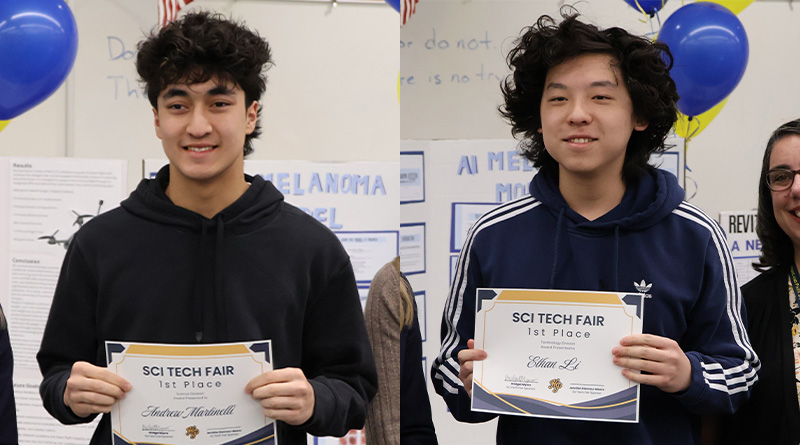
Li showcased SpeakWise during the high school’s SciTech Festival Student Fair. During an award ceremony on Feb. 4, the project won first prize in the technology division and the Jay Ingram Award, a $500 scholarship given in memory of a beloved Highland Park physics teacher.
SpeakWise was one of 10 projects on display from inquisitive and hard-working high schoolers who met as a club to support each other through the scientific process. If they had questions, they could turn for assistance to advanced placement biology teacher Jennifer Giannou-Moore and Highland Park ISD STEAM lead Bridget Myers.
“They came up with a project, and they followed the breadcrumbs so to speak,” Myers said. “It’s honestly very impressive the depth they go to.”
The students’ projects included a study from junior Antony Moussa, who found that even though they’re calorie-free, artificial sweeteners can still affect blood glucose levels, a particularly concerning finding for those who may be diabetic.
Sophomore Katie Kipp found that cooling strategies for young female athletes aren’t only useful on hot days — they also improve recovery in moderate temperatures.
Sophomore Andrew Martinelli won first place in the science division for his study of an environmentally-friendly method of filtering microplastics out of water. Microplastics, his project explained, form when plastic waste breaks down. Plastic is everywhere, and so are the contaminants. Martinelli’s work was inspired in part by his own experiences volunteering at Restorative Farms, a South Dallas nonprofit environmentally affected by contaminants.
Martinelli studied fenugreek polysaccharides, which can be used as filters because they cause microplastics to clump together and sink. He found that the all-natural filters worked better for some microplastics than others. They were most effective with contaminants that derived from PVC pipe, and worked less well with artificial turf.
Martinelli plans to continue exploring different applications of his process.
“Right now, I’m just working on drinking water, so we’ll have to see where that takes me,” he said. “I really found it interesting while researching.”
The projects were judged by a panel that included experts who took part in the high school’s Science and Technology Festival. La Fiesta de las Seis Banderas funded more than $10,000 in student scholarships for the five top projects in the technology and science categories.
All of the students who meet its requirements have the option of competing at the Dallas Regional Science and Engineering Fair on Feb. 28. But Giannou-Moore said that she hopes their spirits of inquiry take them even further.
“I want them to continue to ask the questions and find solutions to real world problems, and to be constantly looking at their environment and asking why. And to be like, ‘hey, I wonder if,’” she said. “And then to try to pursue the wonder if, and see if they can come up with a solution.”
Author