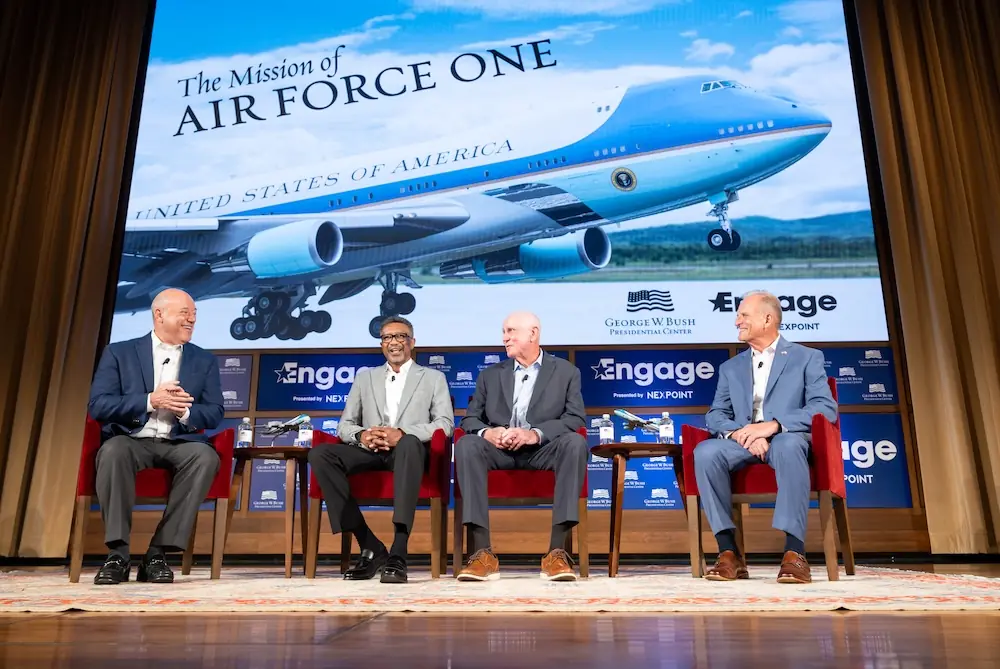
What was it like in Air Force One on Sept. 11, 2001? How many seats are aboard the president’s aircraft? Three former crew members answered those questions and others at a recent event at the George W. Bush Presidential Center.
Air Force veteran Reginald “Reggie” Dickson, Chief Master Sgt. Rick Holley, a Communications Systems Officer who served aboard Air Force One during the administrations of Presidents Ronald Reagan, George H.W. Bush, and Bill Clinton, and retired Col. Mark Tillman, who was George W. Bush’s pilot and commander of Air Force One, told stories of working aboard Air Force One during the “Mission of Air Force One” event Aug. 20. The discussion was moderated by former White House press secretary Ari Fleischer.
Just weeks before the 25th anniversary of the Sept. 11, 2001, terrorist attacks, Tillman spoke about planning to move Bush from the Florida elementary school he was visiting during the crisis back to Washington D.C.
“He was getting incredible amounts of information, and that was the challenge for all of us: information coming at us. It was the fog of war happening,” Tillman said.
Dickson said he was in Washington D.C. on Sept. 11 and recalled getting phone messages from family members of Air Force One crew asking if he had information.
“I was watching for my own concerns, being from New York, seeing what was happening. My wife was working at the Pentagon from time to time at that time,” he remembered.
Dickson and Tillman also recalled executing a covert mission that saw Bush travel from Texas to Baghdad on Thanksgiving in 2003.
“I was fortunate to be a part of a very small cadre of people that knew about the mission early on, but what came with that also was the challenge of where we’re used to having 10 flight attendants prepare meal service aboard the aircraft, it was down to one; myself,” Dickson said.
“The president when he told me about the mission said, as he always does, ‘Tillman, it’s a simple mission. I’m going to leave the United States of America, I’m going to Baghdad for dinner, and then I’m coming back to the United States of America,’” Tillman added.
They also discussed more typical functionality of the plane.
In contrast to commercial planes, the former crew members said Air Force One was designed to work as an airborne office, of sorts.
“Overseas trips, I tell you, were tough. The number of circuits you have are fewer. The likelihood that you’re going to get a head of state call on a long, overseas trip is pretty high,” Holley recalled. “There’s a lot going on on the main deck of the aircraft to support the president, whether you’re working with the speechwriters, the advance agents, the mil aides … they’re doing everything, they’re working legislative issues, trying to get bills worked and signed.”
When asked whether he listened to the president’s phone calls, Holley said, “absolutely.”
“Most people on the airplane, once you got the call up and running, you knew the quality was good, you let it go, and you’d go work another call. You stayed on the president’s call, particularly if it was a head of state call,” he said. “The calls were very demanding; you always had a backup circuit ready to go should you have a call fall down.”
Dickson said his favorite part of working on Air Force One was seeing the crowds gathered outside to watch the plane arrive and see the president.
“Regardless of where we went, from the smallest towns to the biggest cities to the overseas missions, it was always the same,” he said. “When we would land, and we’d pull up, and you see some of the fanfare that’s waiting for the president — it’s just remarkable. It made you proud to be part of the crew.”
At the end of the discussion, the former crew members were asked a series of rapid-fire questions, including whether there’s an escape pod on the aircraft (they all agreed there isn’t) and how many seats are aboard the plane (69, plus space for the first family).
Author